Shopify powers millions of stores, and every one of them eventually needs someone who can do more than drag blocks around in the theme editor. That someone is a Shopify developer, and it's one of the more accessible, well-paid corners of web development to break into. This is the honest roadmap: what to learn, in what order, what to skip, and how the role changed in 2026.
The one-line version
Learn the web fundamentals, then Liquid and the Shopify theme architecture, then how to direct and review AI-generated code. Build real features, not toy exercises. The developers who get hired ship production-grade work and exercise judgment AI can't.
Step 1: The web fundamentals (don't skip these)
Every Shopify theme is HTML and CSS with Liquid (Shopify's templating language) woven through it, plus some JavaScript for interactivity. You can't shortcut this layer. Before touching Shopify, get comfortable with:
- HTML & CSS: structure and styling. You should be able to build a responsive layout without a framework.
- JavaScript basics: variables, functions, fetch, the DOM. You don't need to be an expert, but you need to read it confidently.
- How the browser works: requests, rendering, why performance matters on a storefront.
If you're starting from zero, free resources like MDN, freeCodeCamp, and interactive platforms get you here in a few focused weeks. Don't aim for mastery; aim for fluent enough to read and modify.
Step 2: Liquid and the Shopify object model
This is where Shopify-specific knowledge starts. Liquid is how themes pull data (products, collections, the cart, the customer) into the page. The two things to actually internalize:
- The syntax: output (
{{ }}), tags ({% %}), filters (| money), loops, and conditionals. This is the cheap part now; AI writes it and you'll learn it fast by using it. - The object model: what data Shopify hands every template, and the shape of
product,variant,collection,cart,customer. This is the durable knowledge. Knowing that a price is in cents, or that inventory lives on the variant not the product, is what separates working code from broken code.
Learn this properly · free lesson
Render product pricing the way production themes do
Start here: render a product price the way production themes actually do it (the money filter, not raw cents).
Try this lesson for freeStep 3: Theme architecture (where most tutorials stop short)
Anyone can change a color. A Shopify developer understands how a theme is assembled: sections, blocks, snippets, templates, settings schemas, and locales. Modern themes (Shopify's Horizon architecture and Online Store 2.0) are built from composable sections a merchant rearranges in the editor. You need to know how to build those, not just edit them.
This is the level that makes you hireable, because it's the level where you can take a Figma design and turn it into a theme a merchant can actually run without filing a ticket for every change.
Step 4: Learn to direct and review AI (the 2026 skill)
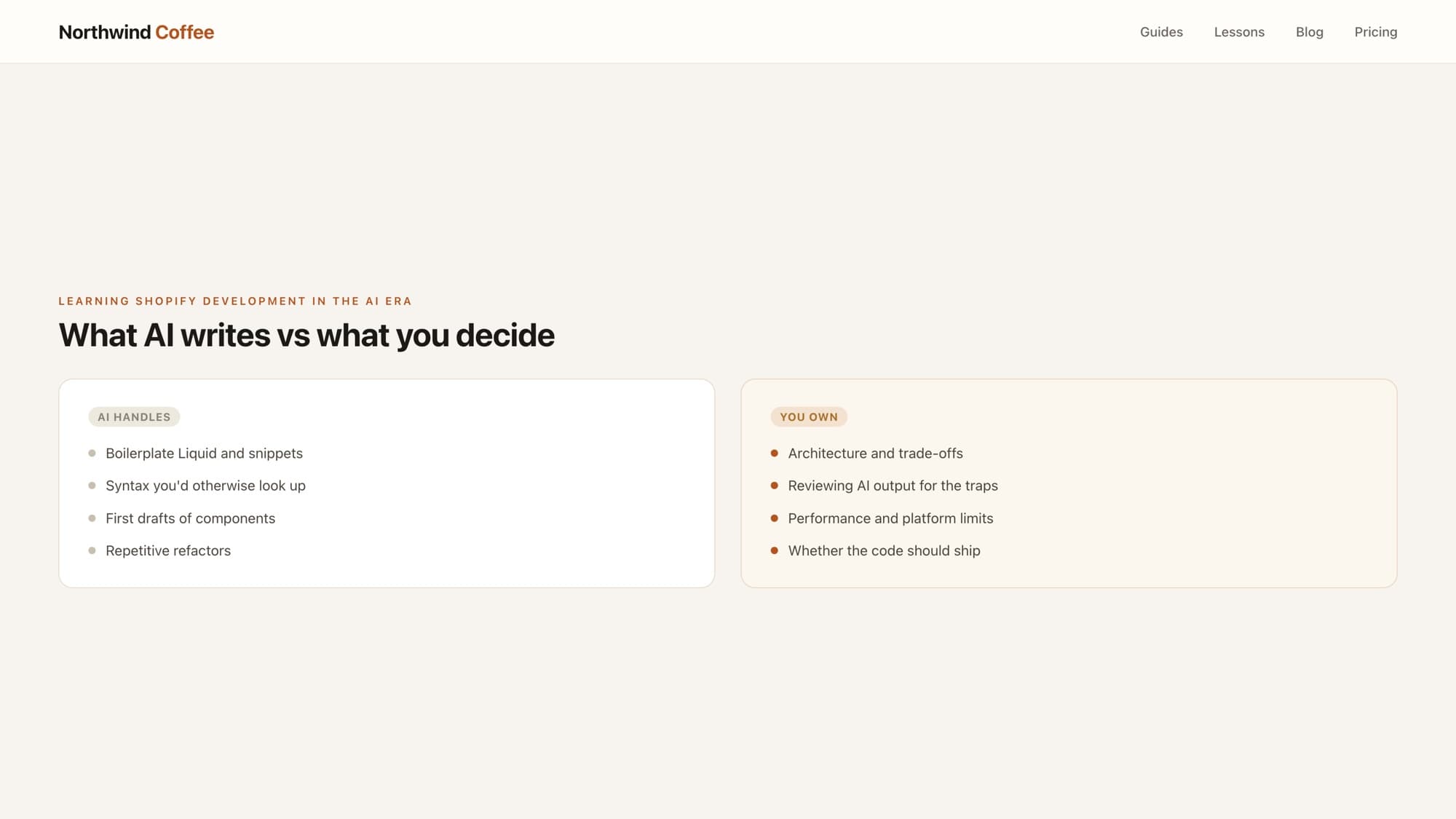
Here's what changed. In 2026, AI writes most of the Liquid. That doesn't make Shopify developers obsolete; it shifts the job from typing to judgment. The valuable developer now:
- Reviews AI output and catches the platform-specific bugs it ships (raw-cents prices, missing availability checks, unguarded metafields).
- Writes precise prompts that produce correct code the first time instead of a broken first draft.
- Debugs fast when generated code compiles but renders wrong.
You can't do any of that without understanding the platform, which is why steps 1-3 still matter. But a roadmap that ignores AI is teaching you for 2019. We wrote a whole post on this if you want the deeper argument.
Step 5: Build real things
Nothing on a CV beats "I built this." Build the features stores actually pay for: a cart drawer, a free-shipping progress bar, a sale badge, a sticky add-to-cart, predictive search. Each one teaches a real pattern and becomes a portfolio piece. Build them against a real theme, not a sandbox toy.
Learn this properly · free lesson
Review the AI's price code
Try the modern loop: review a piece of AI-generated price code and make the accept/revise/reject call.
Try this lesson for freeWhat to skip
- Memorizing every Liquid filter. The reference is one search away and AI knows them all. Understand the categories, look up the specifics.
- Old tutorials built on the Dawn-era or Online-Store-1.0 patterns. Learn the current Horizon architecture; the old way is actively misleading.
- Tutorial purgatory. After the basics, every hour is better spent building a real feature than watching another video.
How long does it take?
With focused effort: a few weeks for the web fundamentals if you're starting fresh, a few more for Liquid and the object model, and then it's about building. Most people can be doing real, paid Shopify work within a few months, faster if they already know HTML/CSS/JS. The ceiling, the senior architecture-and-judgment level, takes longer, but that's true of every craft.
That's exactly the path learnshopify.dev is built around: you're "hired" at a fictional store, you write real Liquid in the browser, and you learn to direct and review AI as you go. The first three modules (Liquid fundamentals, the Shopify object model, theme architecture) are free during the beta if you want to start now.
Frequently asked questions
Do I need a computer science degree to become a Shopify developer?
No. Shopify development is one of the more accessible specialties in web development. What you need is solid HTML/CSS/JavaScript fundamentals, Liquid and the Shopify object model, and a portfolio of real features you've built. No degree required; demonstrable skill is what gets you hired.
Is Shopify development still worth learning if AI writes the code?
Yes, but learn the right thing. AI replaced the typing, not the judgment. The valuable skill in 2026 is understanding the platform well enough to direct, review, and fix AI-generated code, and to make the architecture decisions AI can't. Syntax memorization is a poor bet; platform judgment is a better one than ever.
What should I learn first: Liquid or JavaScript?
HTML and CSS first, then enough JavaScript to read and modify it, then Liquid. Liquid sits on top of HTML, so the markup fundamentals have to come first. You don't need deep JavaScript to start with themes, but you'll need it for interactive features and apps later.
How much do Shopify developers earn?
It varies widely by region, employment type (freelance, agency, in-house), and seniority. Freelance theme work, agency roles, and in-house positions at larger merchants all exist. The constant: developers who can ship production-grade, judgment-driven work command more than those who can only follow a tutorial.
- career
- shopify
- liquid
- roadmap
About the author
Bas Lefeber, Founder, learnshopify.dev
Bas builds learnshopify.dev, where developers learn production-grade Shopify theme development against a live storefront. He writes about Liquid, theme architecture, and the parts of the job that still matter now that AI writes the code.
Keep going in the curriculum