Career
Shopify developer salary in 2026: what you can actually earn
A grounded look at Shopify developer pay in 2026: employed vs freelance, junior vs senior, US vs Europe vs remote, agency vs in-house, and how the AI era changes who earns what.

Bas Lefeber
Founder, learnshopify.dev · June 19, 2026 · 7 min read
"How much do Shopify developers make?" is a fair question with an annoying answer: it depends, and most of the numbers floating around the internet are either inflated by recruiters or deflated by offshore-rate averages. This post pulls the real 2026 figures from the sources worth trusting, separates the situations that actually move pay (level, region, employment type), and tells you what to do if you want to be at the top of the range instead of the bottom.
TL;DR
In the US, a junior Shopify developer role lands roughly in the low-to-mid $80Ks, a generalist around $110K, and a senior commonly $120K-$165K with top earners past $200K (Glassdoor, Salary.com). Freelance varies more wildly than any other axis: $15-$30/hr on the global Upwork median, $50-$80/hr for US-based, $90-$150/hr for top-rated US freelancers, and $120-$200/hr at agency or Plus-architect level. Europe runs lower in absolute terms but comparable after cost of living. The single biggest multiplier in 2026 is no longer location: it's whether you ship production-grade work and exercise judgment, or write syntax AI can now generate for free.
$63k-$116k
Junior, employed
US, annual
$90k-$165k
Senior, employed
US, annual
$50-$150/hr
Freelance, US
by track record
$200k+
Top 10%
senior / architect
Pay by level (employed, US baseline)
Start with full-time employed roles in the US, because that's where the aggregator data is thickest. Treat every number as a range, not a promise. The samples behind some of these are small, and titles like "junior" and "senior" mean different things at different companies.
| Level | Typical salary range (US, annual) |
|---|---|
| Junior | $63k - $116k (low-to-mid $80Ks average) |
| Generalist / mid | $84k - $134k (around $110k) |
| Senior | $90k - $165k (around $120k) |
| Top 10% | $200k+ (senior / architect) |
- Junior: Glassdoor puts the average junior Shopify developer around the low-to-mid $80Ks, with a wide reported band (roughly $63K-$116K). The spread is large because the sample is small and "junior" covers everyone from a bootcamp grad to someone two years in.
- Generalist / mid: Salary.com and ZipRecruiter both center the general "Shopify developer" title near $110K, with the bulk of roles between roughly $84K (25th percentile) and $134K (75th percentile).
- Senior: Glassdoor's senior Shopify developer average sits near $120K, typically $90K-$165K, with 90th-percentile earners reported past $200K.
Working at Shopify itself (the company) is a different and higher market: levelled software-engineer comp there reaches well into six figures and beyond. That's a distinct career from "I build Shopify themes and apps for merchants," which is what this post is about.
Employed vs freelance
This is the axis with the widest spread, and the one where averages lie hardest. The global Upwork median for a Shopify developer is genuinely low (around $15-$30/hr) because it pools thousands of offshore configurators with senior architects. Filter that same data and the picture changes completely:
- Global median (Upwork, all comers): roughly $15-$30/hr. This is the number people quote to argue Shopify pays badly. It's mostly entry-level offshore work.
- US-based freelancers: the median jumps to about $50-$80/hr once you filter for US location.
- Top-Rated US freelancers: roughly $90-$150/hr for proven, well-reviewed developers.
- Senior / Plus / headless specialists: $120-$200/hr and up, with enterprise architects reportedly billing $200/hr or more for migrations and headless builds.
Freelance has a higher ceiling and a lower floor. An employed senior trades the top-end hourly rate for stability, benefits, and not having to sell. A booked-solid freelancer at $120/hr can clear well past any salaried equivalent, but "booked solid" is the load-bearing phrase. The honest framing: freelance pays more per hour at the top and less reliably across the year. Most developers do best employed first, then go independent once they have a network and a niche.
By region: US, Europe, and remote
Region is real but smaller than people assume, especially once remote work flattens the field. Absolute numbers are highest in the US; Europe runs lower in headline terms but often comparable after cost of living and benefits.
- United States: the baseline above. Employed generalists near $110K, seniors $120K-$165K-plus. US-based freelance commonly $50-$150/hr depending on track record.
- United Kingdom: levelled engineer comp at Shopify spans roughly £53K (junior) to £180K (senior), per Levels.fyi. Independent UK and Western-European agency work bills around £90-£160/hr at the firm level.
- Germany / Western Europe: Levels.fyi shows Shopify engineer comp in Germany roughly €99K-€186K across levels. Independent rates run about €55-€95/hr for theme developers and €130-€220/hr for Plus architects.
- Eastern Europe / offshore: lower headline rates (senior execution reported around $27-$38/hr) for comparable skill, which is exactly why remote competition is real and why being merely cheap is a losing position.
- Fully remote: a dedicated full-time remote developer costs a merchant roughly $3,000-$6,000/month outside the US and $7,000-$12,000/month for US or Western-European talent, per agency cost guides. Remote doesn't erase the regional gap, but it lets a strong developer anywhere bill above their local market.
Agency vs in-house vs solo
Where you sit changes both the number and the shape of the work.
- Agency: US and Canadian agencies bill clients roughly $120-$200/hr; UK and Western-European firms $90-$160/hr. Your salary is a fraction of the billed rate, but agencies are the fastest way to see many stores, learn review discipline, and level up early.
- In-house: one brand, deeper context, usually a salaried role in the bands above. Steadier, less variety, strong if you want to own a storefront long-term.
- Solo / freelance: highest ceiling and highest variance. You're also running a business: sales, scoping, invoicing, support. The developers who thrive solo are the ones who picked a niche (conversion work, Plus migrations, a specific vertical) rather than competing on "I do Shopify."
What actually moves you up the range
Across every source, the pattern is identical: the title sets the band, but a handful of capabilities decide where inside it you land.
- Architecture, not edits: being able to take a design and build a maintainable theme a merchant can run, instead of patching one, is the jump from $80K to $120K-plus.
- A specialty that's hard to fake: Plus, headless / Hydrogen, performance, conversion. The 2026 premium tier is consistently the developers who do enterprise migrations and headless builds.
- Production judgment: catching the bugs that compile but render wrong, knowing platform constraints, reviewing other people's (and AI's) code. This is what separates the senior band from the junior one.
- A portfolio of real work: shipped stores and features beat any certificate. It's also what justifies the top freelance rate.
The AI era (and the Spring '26 shift)
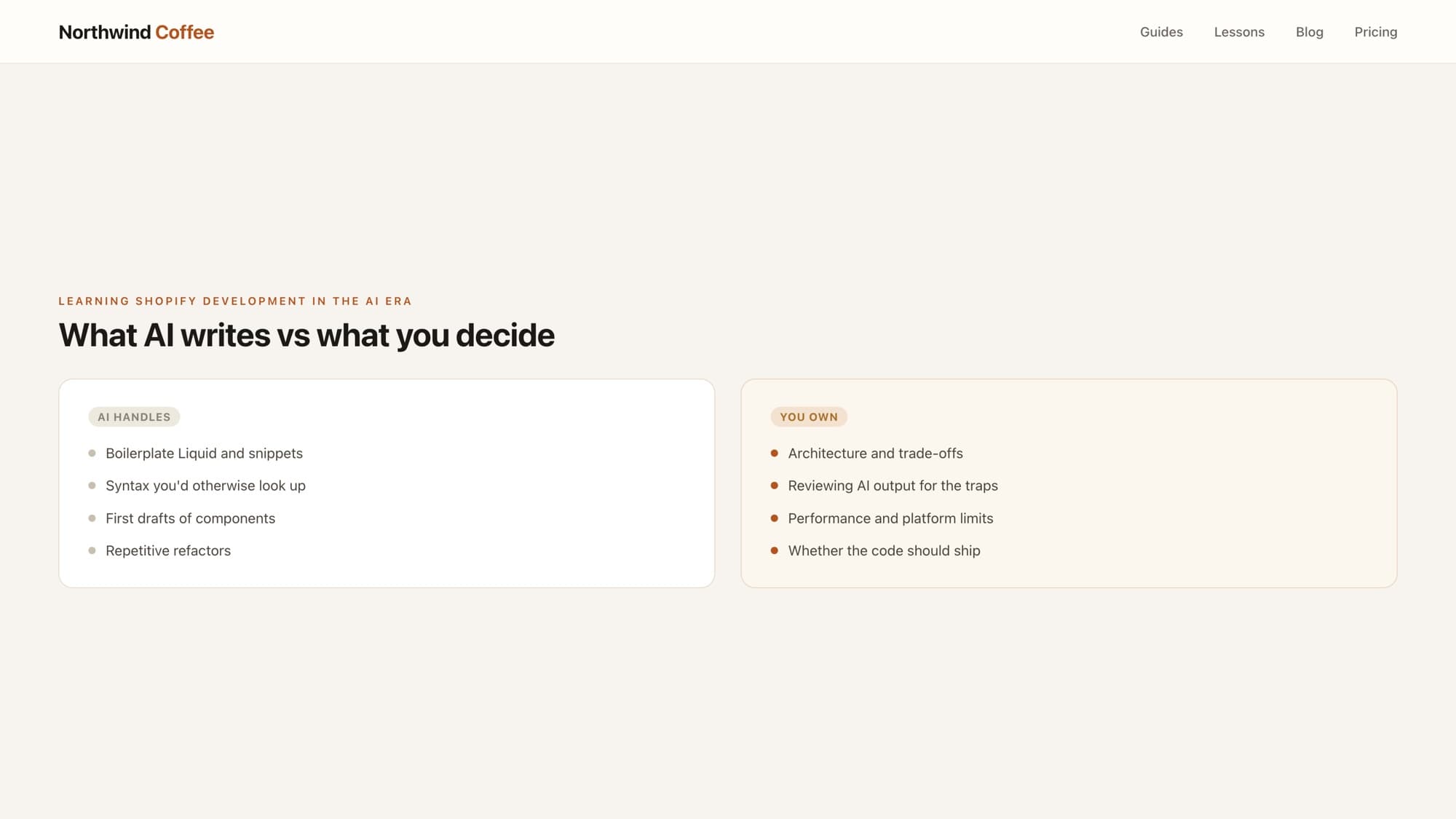
Here's the part that reshapes the salary question. AI now writes most of the Liquid and a lot of the JavaScript. If your value was typing syntax, that value is collapsing toward the global-median rate, because a model does it for free and an offshore developer does it for $15/hr. That's the floor falling out from under the bottom of the range.
The Spring '26 Edition made this concrete. Shopify rebuilt its developer platform around the assumption that an AI agent (not only a human) is building and buying on the platform: the Universal Commerce Protocol opened to every developer with no approval step, Hydrogen moved toward framework-agnostic, and the app and webhook layers were reworked for agentic, protocol-aware commerce. The plumbing got easier. The judgment got more valuable.
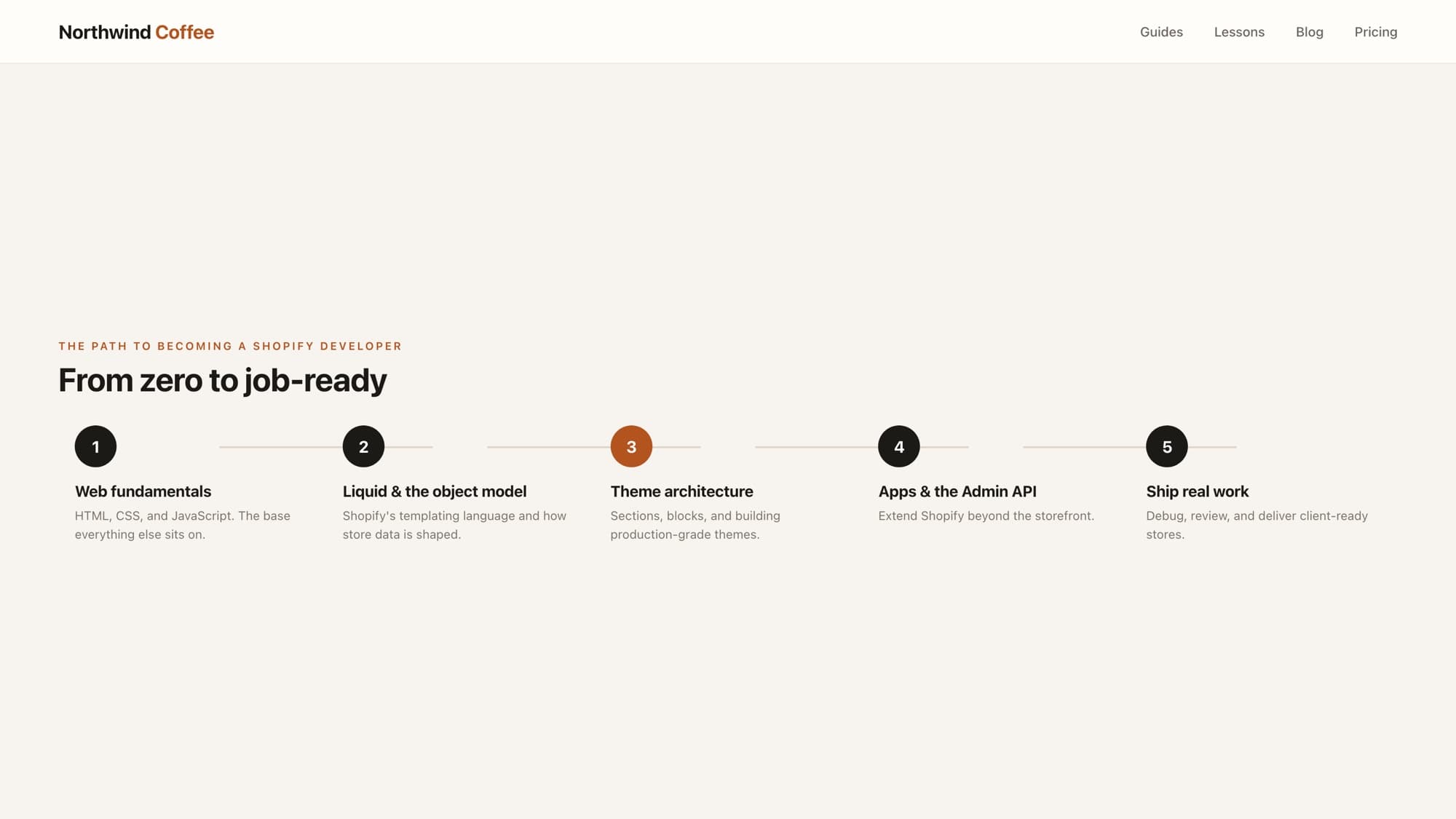
So the earning split in 2026 is less junior-vs-senior and more this: developers who exercise judgment and ship production-grade work command the upper bands, while developers who only produce syntax AI can generate get squeezed toward the floor. Directing and reviewing AI output, making the architecture call, and owning correctness on a real store are the durable, well-paid skills. We made the full argument here, and if you're at the start of the path, the realistic roadmap is here.
Learn this properly · free lesson
Render product pricing the way production themes do
Start your first day: you're "hired" at a store and write real Liquid against a live theme. The first lesson renders a product price the way production code does it, the kind of correctness that puts you in the upper band.
Try this lesson — freeThe honest bottom line
Shopify development remains one of the more accessible, well-paid corners of web work, and the ceiling is rising for the right people. Expect a wide range, expect region and employment type to matter, and expect 2026 to reward judgment over typing more than any year before it. Aim to be the developer who ships production work and reviews the AI, not the one the AI replaces.
Frequently asked questions
How much do Shopify developers make in 2026?
In the US, employed roles broadly range from the low-to-mid $80Ks for juniors to roughly $120K-$165K for seniors, with a generalist average near $110K (Glassdoor, Salary.com, ZipRecruiter). Freelance ranges far wider, from a $15-$30/hr global Upwork median up to $120-$200/hr-plus for senior, Plus, and headless specialists. Treat all of these as ranges; level, region, and employment type all move the number.
Do freelance Shopify developers earn more than employed ones?
They can, but with more variance. The top freelance hourly rate (roughly $90-$150/hr for top-rated US developers, $120-$200/hr-plus for Plus architects) beats most salaries on a per-hour basis. The catch is utilization: a freelancer only earns when booked, and has to handle sales, scoping, and support. Employed roles trade the top-end rate for stability and benefits. Most developers do best employed first, then go independent with a niche and a network.
Is Shopify development still worth it in 2026 if AI writes the code?
Yes, but the money has shifted toward judgment. AI now generates most of the syntax, so pay for pure typing is collapsing toward the global-median rate. The well-paid work in 2026 is architecture, debugging, platform judgment, and directing and reviewing AI output, exactly the skills the Spring '26 agentic shift made more valuable, not less. Learn those, not syntax memorization.
Why are online Shopify developer salary numbers so different?
Because they measure different populations. The low Upwork medians pool offshore entry-level work with senior architects; recruiter averages skew high; aggregator samples for niche titles like 'junior Shopify developer' are small and noisy. Always check the source and the population before trusting a single figure, and reason in ranges.
Start free
Ready to become a Shopify developer?
You just read how it works. Now write it yourself: real tickets from a live store, in an editor where the storefront updates as you type. Module 1 is free, no card.
Free · No credit card · Your first win in minutes
About the author
Bas Lefeber, Founder, learnshopify.dev
Bas builds learnshopify.dev, where developers learn production-grade Shopify theme development against a live storefront. He writes about Liquid, theme architecture, and the parts of the job that still matter now that AI writes the code.
Keep going in the curriculum